No Reviews, No Call? Why Google Reviews Matter More Than You Think
You can be the best plumber in town.
Your technicians can show up on time. Your electricians can clean up after themselves. Your HVAC company can fix the problem without trying to sell Grandma a brand-new system she doesn't need.
There's only one problem.
The person searching Google doesn't know any of that yet.
They pull out their phone and search:
"HVAC company near me."
"Emergency plumber."
"Roof repair near me."
Three companies catch their attention.
One has 4.9 stars and 187 reviews.
Another has 4.8 stars and 63 reviews.
Yours has 5.0 stars and 7 reviews.
Who gets the call?
Maybe you.
But would you bet your next $5,000 job on it?
That's why Google reviews aren't just little gold stars sitting beside your business name anymore.
For a local service business, they're part word of mouth, part sales department, part trust signal and part first impression.
And they're working 24 hours a day—whether you're paying attention to them or not.
Almost Everybody Is Reading Reviews
Let's start with a number that's hard to ignore.
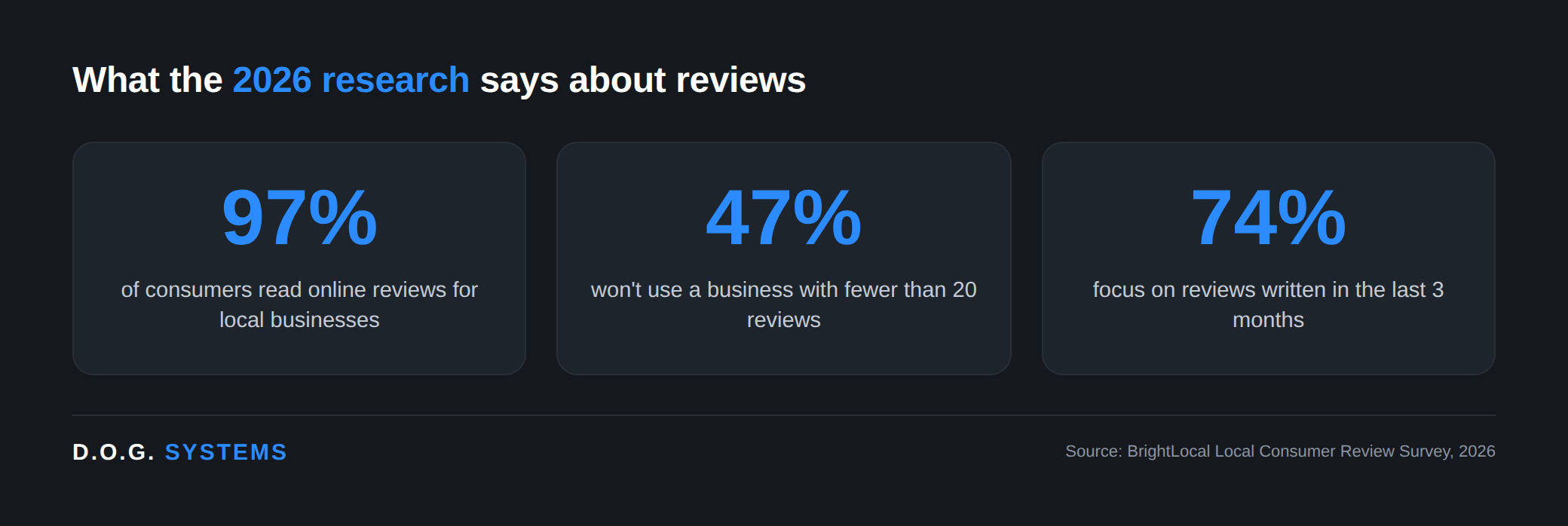
BrightLocal's 2026 Local Consumer Review Survey found that 97% of consumers read online reviews for local businesses.
Not 60%.
Not 75%.
97%.
That means the person looking you up online is probably reading what your previous customers had to say before deciding whether you're getting the call.
This matters even if you proudly say:
"Most of our business comes from word of mouth."
That's great.
Word of mouth is powerful.
But here's what happens now:
Bob tells his neighbor, "Call Johnson Heating. They did a great job for us."
The neighbor says thanks.
Then what does he do?
He Googles Johnson Heating.
The referral got you into the race.
Your online presence can still influence whether you finish it.
And customers aren't researching 25 companies before making a decision.
BrightLocal's 2026 consumer-search research found that 72% of consumers consider three or fewer businesses before choosing one.
Only 6% simply click the top result.
So ranking well matters—but being seen isn't enough.
Once you're on the screen, the customer starts comparing.
Stars. Number of reviews. What people are saying. How recently they're saying it. How the business responds.
Welcome to the modern-day version of asking your neighbor who they recommend.
Except now your entire town gets a vote.
A Perfect 5.0 Isn't Always Enough
Here's where things get interesting.
Let's say you have a perfect Google rating.
5.0 stars.
Sounds great.
Now let's add the part underneath it.
7 reviews.
That tells a different story.
BrightLocal's 2026 research found that 47% of consumers won't use a business with fewer than 20 reviews.
Think about that.
Your seven customers might absolutely love you.
You could have seven perfect reviews.
Not one complaint.
Not one unhappy customer.
And nearly half of the consumers surveyed said a business with fewer than 20 reviews wouldn't make the cut.
Why?
It's not necessarily because they think you're bad.
There's simply less proof.
A stranger searching Google doesn't know you've installed 400 air conditioners over the last decade.
They don't know you've repaired hundreds of leaking pipes.
They don't know you've replaced roofs all over town.
They see what Google shows them.
So compare these:
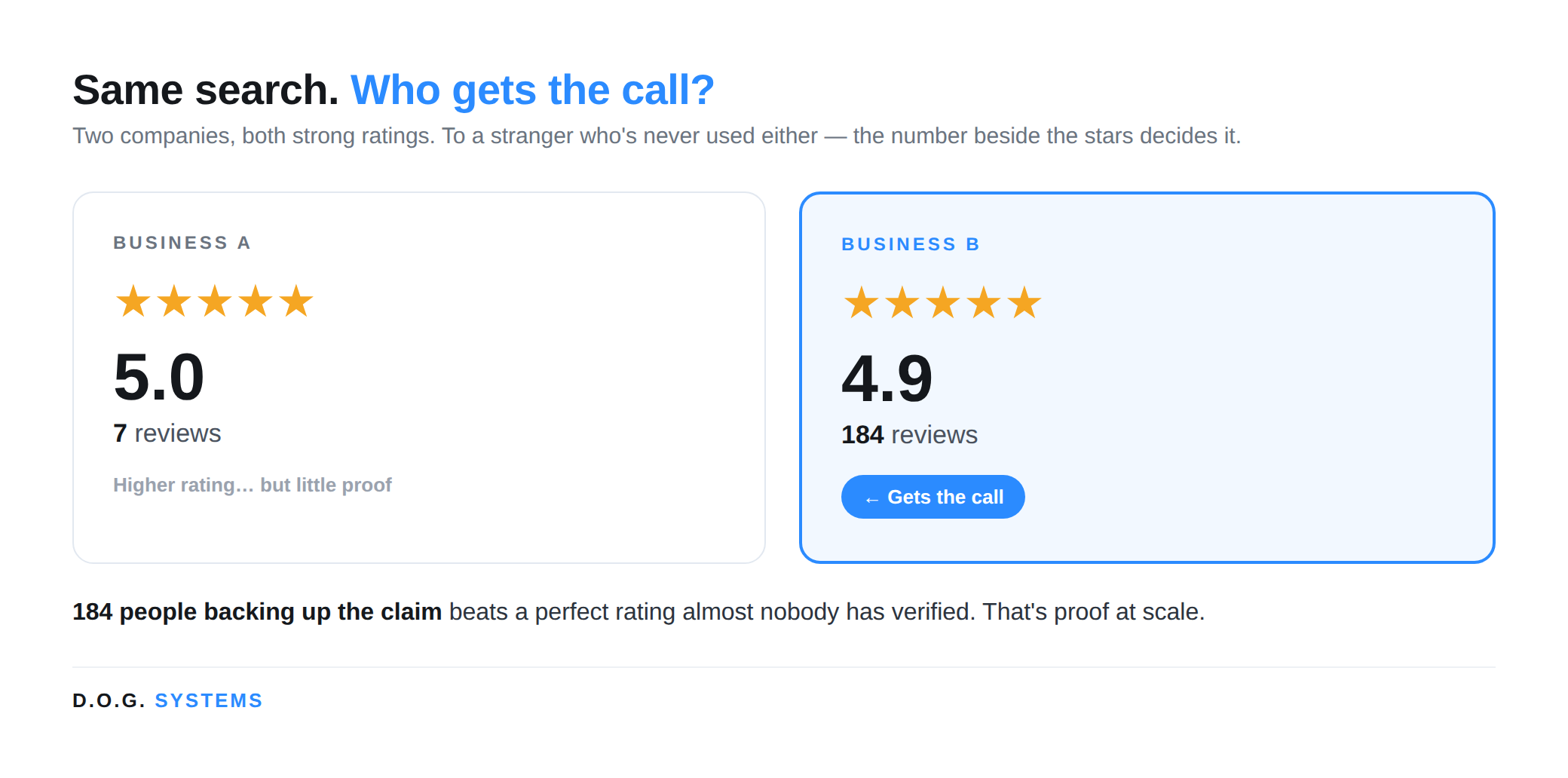
Business A— 5.0 stars, 7 reviews
Business B— 4.9 stars, 184 reviews
Which feels safer to someone who has never dealt with either company?
Business A technically has the higher rating.
Business B has something powerful:
184 people backing up the claim.
That's proof at scale.
It's the difference between one guy at the bar saying, "Trust me, these guys are good," and half the bar turning around and saying, "Yep. Used them too."
Consumers Look at BOTH the Stars and the Number Beside Them
The review count isn't just decoration.
When BrightLocal asked what mattered while researching a local business, 92% of consumers said they care about star ratings—but remember, 47% won't use a business with fewer than 20 reviews.
Customers aren't only asking:
"Are they rated well?"
They're also asking:
"How many people agree?"
That's why having a 5.0 rating doesn't mean your review strategy is finished.
Especially if you've been in business for 15 years and your Google profile has 12 reviews.
A potential customer doesn't know whether you never ask for reviews, you barely do any business, your profile is new, or you just haven't paid attention to Google.
They only know what they see.
And Customers Are Getting Pickier
The bar is getting higher.
BrightLocal reports that 31% of consumers will only use businesses rated 4.5 stars or higher.
That means having reviews matters.
But having good reviews matters too.
There's another reason building a healthy base of reviews is important.
Imagine your business has two 5-star reviews.
Then one angry customer leaves you a 1-star review.
Your new average?
3.67 stars.
Ouch.
Now imagine you have fifty 5-star reviews.
One customer leaves the exact same 1-star review.
Your average?
Approximately 4.92 stars.
Same unhappy customer.
Same 1-star review.
Completely different effect.
A larger collection of genuine customer feedback doesn't make negative reviews disappear—and it shouldn't.
It gives potential customers a more complete picture of the business instead of allowing one experience to define the entire company.
Yesterday's Reviews Aren't Enough
Here's another mistake businesses make:
"We've already got reviews."
Great.
When did you get them?
Because customers pay attention to that too.
BrightLocal's 2026 research reports that 74% of consumers focus on reviews written within the previous three months.
A glowing review from 2021 is still valuable.
But imagine you're the customer.
You land on a contractor's Google profile.
Five stars.
Nice.
Then you notice:
Last review: 8 months ago.
The next one? 11 months ago.
Then fourteen months.
Your brain starts asking questions.
Are they still busy? Are they still operating? Did ownership change? Are the same employees there? Is the service still good?
You shouldn't expect a customer to conduct an archaeological dig through your Google profile to figure out whether you're still alive.
Recent reviews answer a simple question:
"What is this company like right now?"
That's why successful review generation isn't about collecting 50 reviews once and declaring victory.
It's about creating a steady stream of recent customer experiences.
Reviews Can Help You Get Found, Too
So far we've talked about what happens after a customer finds your business.
But reviews can also be part of getting found in the first place.
Google says local search rankings are primarily influenced by three factors:
Relevance— how well your business matches what the person is searching for.
Distance— how far your business is from the person searching.
Prominence— how well-known or established the business appears.
And Google specifically states that more reviews and positive ratings can help a business's local ranking.
That doesn't mean:
20 new reviews = automatic #1 ranking.
If somebody promises you that, keep one hand on your wallet.
Local rankings involve multiple factors, including location, competition, your Google Business Profile, your website, links and other signals.
But reviews are one of the factors Google publicly acknowledges.
And that's important.
Think You Rank #1 on Google? Look at the Heat Map.
This is one of the coolest—and most eye-opening—things a local business owner can see.
Pull out your phone while you're standing at your office.
Search: "HVAC company near me."
You show up #2.
Beautiful.
You might think: "We're killing it on Google."
Not so fast.
Move a few miles across town. Run the same search.
You might be #5.
Move farther into another neighborhood.
You might be #11.
Go to the opposite side of your service area.
You may barely show up at all.
Your Google Maps ranking isn't one fixed number.
Where the person is standing matters.
Remember that distance factor Google talks about?
This is where you can actually see it happening.
A local-search heat map, often called a geo-grid, checks a search from multiple geographic points around a business. Instead of saying "you rank #4," it can show how you rank from 25, 49, 81 or more individual points across your market:
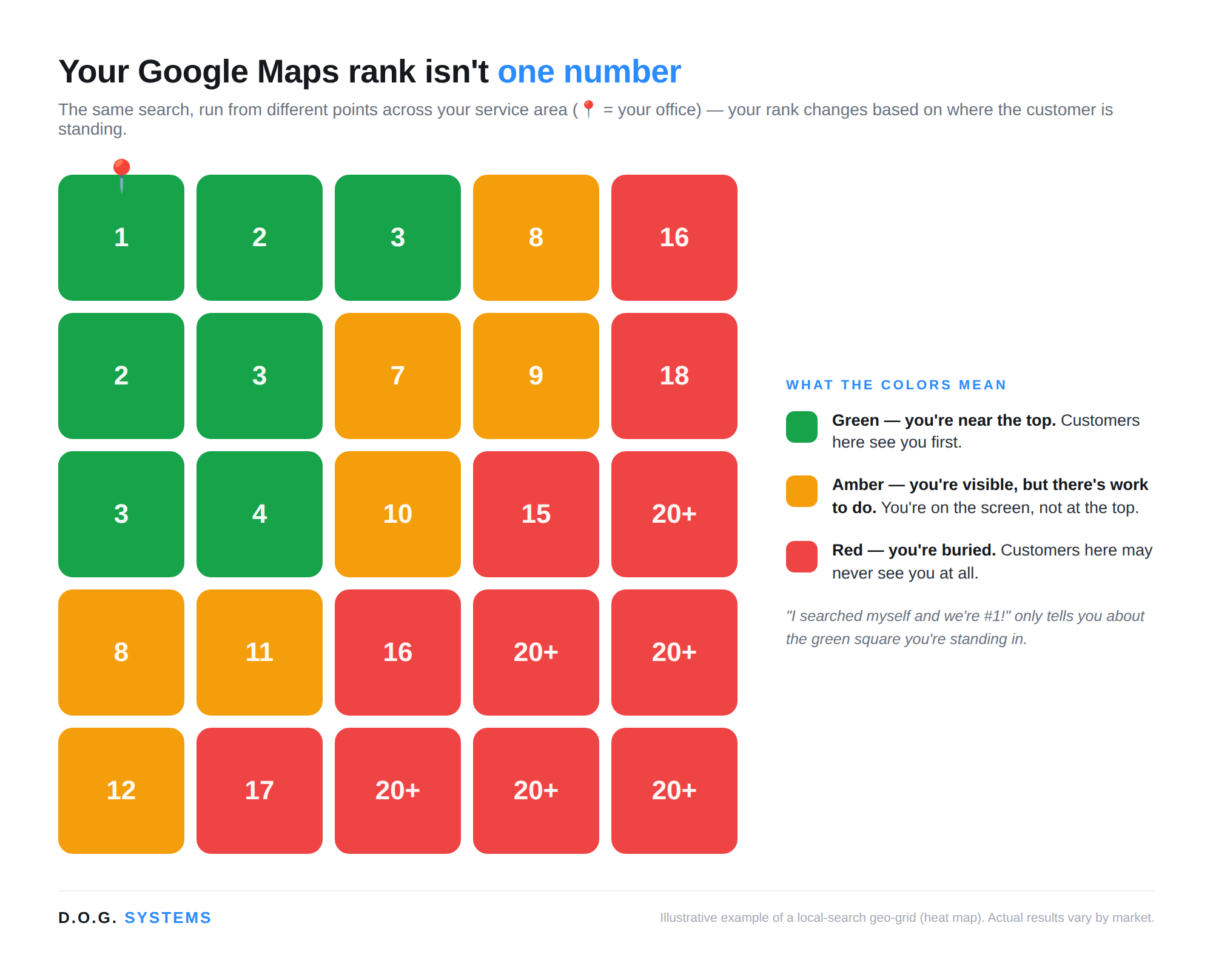
Generally speaking:
Green= You're near the top
Yellow/Amber= You're visible, but you've got work to do
Red= You're buried far enough down that customers may never see you
Suddenly, "I searched myself and we're #2!" doesn't tell the whole story.
Now Imagine This Is Your Actual Service Area
Let's say you're an HVAC contractor.
Your office is in one part of town, but you happily service customers 15 miles in every direction.
Near your office? Your heat map is beautiful. Lots of green.
Five miles east? Yellow starts appearing.
Ten miles away? Red everywhere.
Now you know something important.
Customers in part of your actual service area may have a very different experience searching for you than customers near your office.
That's information you can't get by Googling yourself once while sitting behind your desk.
So Will More Reviews Turn the Whole Map Green?
Not automatically.
And anyone telling you otherwise is oversimplifying local search.
Remember Google's three big factors: Relevance. Distance. Prominence.
You can't change where a customer's house is located.
Reviews are also not the only thing affecting prominence.
Your website matters. Your Google Business Profile matters. Your business information matters. Competition matters. Links and other signals matter.
But Google specifically acknowledges review count and positive ratings as factors that can help local ranking.
So a strong, active review profile is one piece of strengthening your local presence.
That's what makes a heat map so useful.
Instead of vaguely saying "I think we're doing better on Google," you can establish a baseline.
Look at the map today. Improve the things within your control. Continue earning legitimate customer reviews. Improve your profile. Improve your website and local presence. Then run the map again later.
The goal? More green.
Now you're measuring visibility instead of guessing.
Reviews Don't Just Build Trust. They Move People.
This is where reviews stop being a vanity metric.
They're not baseball cards.
Nobody wins a trophy for collecting the most Google reviews.
The point is what happens after someone reads them.
A homeowner with a dead air conditioner isn't reading HVAC reviews because they've recently developed an exciting new hobby.
They have a problem.
A homeowner with water pouring through the ceiling isn't fascinated by the rich cultural history of local roofing companies.
They're trying to answer one question:
"Who can I trust to fix this without screwing me?"
Reviews help answer that question before you've ever spoken to the customer.
And the effect of visible ratings isn't purely theoretical.
Harvard Business School researcher Michael Luca studied Yelp ratings alongside revenue data from independent restaurants.
His research found that a one-star increase in Yelp rating was associated with a 5% to 9% increase in revenue for independent restaurants.
Now let's be clear.
That study examined restaurants and Yelp.
It does not mean moving your plumbing company from 4.0 to 5.0 stars automatically produces exactly 9% more revenue.
That's not what the research says.
What it does demonstrate is that publicly visible customer ratings can influence real purchasing behavior, not merely people's opinions.
And for a service business where one new customer can be worth hundreds, thousands or tens of thousands of dollars?
That's worth paying attention to.
Here's the Crazy Part: Your Happy Customers Will Often Review You
At this point you may be thinking:
"Okay, but customers don't want to leave reviews."
Apparently, a lot of them do.
BrightLocal's 2026 survey found that 94% of consumers are open to writing a review.
Even better: 83% of consumers who had been asked to leave a review said they went on to leave one.
That's a massive clue.
The problem often isn't "my customers won't review me."
It's "nobody consistently asks them."
Think about a normal service call.
You finish the job. The customer loves it. They thank you. You collect payment. You shake hands. You drive away.
Then their phone rings. The kids need dinner. The dog decides the living-room rug would be a fantastic place to throw up. Work emails start coming in. Tuesday happens.
And the Google review they were absolutely willing to leave becomes item #147 on their mental to-do list.
That's why "we provide great service and hope people review us" is not really a review strategy.
You need to ask.
And ideally you need to ask while the positive experience is still fresh.
Make it simple. Make it quick. Don't make the customer hunt for your Google profile like they're searching for buried treasure.
Don't Forget the Reviews You Already Have
Getting the review isn't the end.
Customers are watching what businesses do afterward.
BrightLocal's 2026 research found:
89% of consumers expect businesses to respond to reviews.
And 80% say they're likely to use a business that responds to all of its reviews.
Meanwhile, 42% say they're unlikely to use a business that completely ignores its reviews.
So yes: answer them. The positive ones. The negative ones. Even the short ones.
But there's another catch.
Please don't respond to 74 customers with:
"Thanks for your review!"
"Thanks for your review!"
"Thanks for your review!"
By review #12, it starts looking less like gratitude and more like your keyboard only has four working keys.
BrightLocal found that 50% of consumers may be less likely to choose a business when its responses appear generic or templated.
Your reply doesn't need to be Shakespeare.
Just sound like somebody actually read what the customer wrote.
"Thanks, Mike. Glad we could get the AC back up before the weekend."
That's infinitely more human than:
"Thank you for your valued feedback."
Nobody talks like that.
What Actually Happens When You Don't Have Enough Reviews?
This is the scary part.
Usually? Nothing obvious happens.
Your truck doesn't explode. Google doesn't send someone to repossess your ladders. Your phone doesn't immediately stop ringing.
That's why the problem is so easy to ignore.
Instead, you lose customers you never knew existed.
Somebody searches for your service. They see you. They see two competitors.
Competitor A has recent reviews. Competitor B has lots of reviews. Both have strong ratings.
You have nine reviews and the newest one is from six months ago.
The customer picks one of them.
That's it.
You don't receive an email saying:
"Congratulations! Mike almost called you about a $9,000 HVAC replacement today, but another company looked more established online."
Mike just disappears.
And tomorrow another Mike searches. Then Susan. Then Bill. Then the property manager who needs three units replaced.
You can't measure every job you never had the opportunity to quote.
That's what makes poor online visibility expensive.
You Don't Need 500 Reviews Tomorrow
Don't turn this into another impossible business-owner project that gets written on a whiteboard and ignored for the next nine months.
You don't need to wake up tomorrow with 500 Google reviews.
You need something much less exciting:
A system.
Provide service worth talking about.
Ask customers for feedback consistently.
Make leaving a review easy.
Continue generating recent reviews.
Respond like a human being.
Track what's happening.
Repeat.
Ten reviews become twenty. Twenty become thirty. Thirty become fifty.
And each new customer searching for your business sees a growing body of evidence saying:
These people show up. They do good work. Other customers trust them. I probably can too.
Reviews Aren't Trophies. They're Proof.
You already know whether your company does good work.
Your employees know. Your repeat customers know. Your family probably knows.
But that's not the problem.
The stranger searching Google at 9:30 tonight doesn't know.
They're looking at you. They're looking at your competitors. And they're trying to make a decision quickly.
Your reviews help answer:
Are these people legitimate? Can I trust them? Are customers still happy with them today? Do they actually do much business? Do they care enough to respond when customers speak up?
And when reviews are combined with a strong Google Business Profile, website and local-search presence, they can become part of something even bigger: getting found in the first place.
So don't think of your reviews as a collection of stars.
Think of them as what they really are:
Evidence. Evidence that you've done the work. Evidence that customers trusted you. Evidence that you delivered. And evidence that might help the next person choose you instead of the guy two listings down.
Want to See What Customers See?
You look at your business every day.
But you've probably never looked at it the way a potential customer does.
How does your review profile compare with your local competitors? Are your reviews recent? Are you showing up across your actual service area—or only near your office? Where are the gaps?
D.O.G. Systems offers a free business audit that takes a look at your current online presence and identifies opportunities you may be missing.
No hard sell. Just a clearer picture of where you stand—and where there may be room to grow.
→]Sources:BrightLocal Local Consumer Review Survey 2026;BrightLocal Consumer Search Behavior 2026;Google Business Profile Help — Local Ranking;Harvard Business School — Reviews, Reputation, and Revenue (Luca).
